
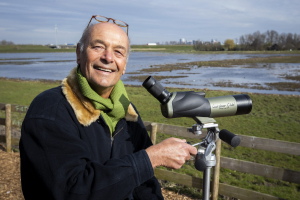
Roeland Bertrams, a remarkable man
Monday, December 22, 2025
Roeland Bertrams - In memoriam
With the passing of Roeland Bertrams, DDV loses a member who, for decades, made a decisive contribution to the face and functioning of the association. Many know Roeland as a committed board member, a sharp thinker, and a warm advocate of an open and active club culture.
Roeland became a member of DDV in 1978, at a time when the association still used the old-fashioned balloting system. A few years later, following a general meeting, he approached the board asking if he could be of service to the club. That typifies him: not waiting around, but taking responsibility. From 1986 onwards, he was part of the board and played a key role in transforming the balloting from a defensive instrument into an active and welcoming reception for new members. The introductory evenings, partly shaped by Roeland, grew into gatherings where new members could immediately feel at home within DDV.
In 1999, Roeland took over the gavel and led the association during a period of significant changes, culminating in the merger with Ready ’28 in 2001. The care and dedication with which this process was carried out laid a solid foundation for the current DDV. In 2002, Roeland handed over the chairmanship. That same year, in recognition of his years of service, he was appointed Member of Merit.
Even after his term on the board, Roeland remained closely involved with the club. He made a substantial contribution to the 100 Years anniversary book, which was published in 2004 and which he helped to create. In this book, his love for the association and his eye for detail are clearly evident. He often expressed his conviction that a club is shaped by the dedication of its members, and that active involvement makes DDV a pleasant association—and he lived by it.
His involvement was not limited to structure and policy alone. Roeland was also visibly present in the daily club operations. He was the connecting factor within several regular tennis groups, both during the day and in the evening. Roeland drew up playing schedules, arranged substitutes when necessary, and ensured that everyone could keep participating. That role of quiet organizer suited him well.
In addition, he had been part of a regular Tuesday evening group for nearly forty years. On the court, Roeland would occasionally make a mistake regarding whether a ball was in or out and did not hesitate to engage in a discussion about it. This invariably ended in a joint decision to play a let – sometimes with amused interference from players on the adjacent court. After tennis, the group traditionally stayed together to chat, have drinks, and play Toepen. Roeland also liked to bend the rules to his will during Toepen, which led to a few extra rules within the group. The fact that he occasionally pulled out a sandwich he had brought from the office to do so was typical of him.
Roeland was known for his down-to-earth approach to money. He considered new tennis clothing a waste of money; for years, he appeared on the court in the same outfit. The fact that some club members eventually felt this was no longer acceptable and, on their own initiative, ensured that Roeland appeared on the court in new attire again, typifies both his frugality and the affection he evoked in many. At the same time, he never lacked consideration for others. For instance, he invariably ensured that a bouquet of flowers was presented at the end of the year to the person who organized the Saturday afternoon tennis – as a token of appreciation.
Roeland considered expressing appreciation important. He liked to take a moment to thank people for their efforts, big or small. He did this not only formally, but above all personally. He was a loyal and committed friend who considered it only natural to regularly visit fellow club members for whom life was less easy at that moment. That attention was greatly appreciated.
Roeland remained actively involved with the association in recent years as well. As a member of the advisory group, he provided the board with solicited and unsolicited advice. In addition, he took on significant responsibility for the revision of the statutes. Sadly, he did not live to see the General Meeting where this amendment was discussed, but the result of his efforts is visible in the ultimately adopted amendment to the statutes.
It is difficult to imagine that Roeland will no longer be present at DDV. His commitment, his words of thanks, and his care for others will be missed. We look back with gratitude on everything he has meant to the association. Thanks in part to his efforts, DDV has become what it is today.
We are going to miss you, Roeland. DDV owes you a great debt of gratitude.